
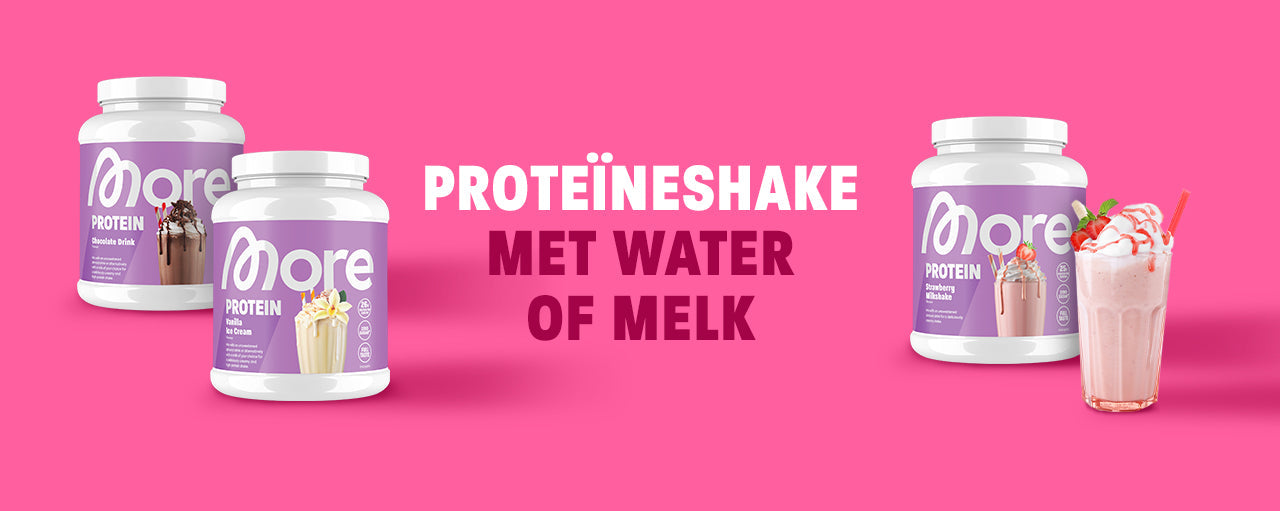
There are so many different ways to prepare your protein shakes
People active in the fitness industry often wonder if they should **make their protein shake with milk or water**. However, the choice is greater than you might think. There are **countless combinations possible**, from water to skim milk and plant-based milk alternatives.
Which component is best for your shake **depends mainly on you**. While all combinations have certain advantages and disadvantages, when choosing the right mix, you should pay attention to the desired taste and the type of diet you are following. **Individual tolerances** should also make your choice between water and milk or plant-based alternatives easier.
If you want to combine your protein shake with water or milk and are currently on a diet or counting calories, the choice is quickly made. In that case, it is better to use water. On the other hand, different types of milk offer the opportunity **to add new flavors** and even transform a simple pre-workout shake into a true taste experience. The right preparation method often depends on **how many carbohydrates** you want to consume at that moment. Depending on that, you can then adjust your protein intake to your diet and the right training. So: protein shake with water or milk - what's better? We'll tell you everything you need to know.
[[FAQ-]]
[ITEM-]
[Q-]Can you mix shakes with water? [-Q]
[A-]Shakes can be mixed with (skim) milk, plant-based milk alternatives, but also simply with water. When you mix the shake with water, it is not only lower in calories, but it is also digested more quickly.[-A]
[-ITEM]
[ITEM-]
[Q-]How do you drink a protein shake correctly?[-Q]
[A-]A protein shake can be consumed 1 to 3 times a day. The serving size is indicated on the packaging. It is best to take the shake immediately after waking up and before or after training. It can be prepared with water, (skim) milk or a plant-based milk alternative.[-A]
[-ITEM]
[ITEM-]
[Q-]How quickly should you drink a protein shake?[-Q]
[A-]Contrary to earlier assumptions, there is no anabolic window directly after training in which you absolutely must consume protein. It is much more important to consume enough protein throughout the day – including around your training.[-A]
[-ITEM]
[ITEM-]
[Q-]How many calories does a protein shake with water contain?[-Q]
[A-]Because you save calories from milk when preparing with water, a protein shake with water logically contains fewer calories. The number of calories varies per manufacturer, protein type and flavor. A guideline value per serving of 50 g is approximately 180 calories.[-A]
[-ITEM]
[[-FAQ]]
More protein & more taste? Make a protein shake with milk.
Many people ask themselves: can you drink protein shakes with milk? Of course you can, and it offers you a number of tasty alternatives to water. Because there are so many **types of milk** on the market, you are truly offered variety as a connoisseur. While some people prefer to try different flavors, there are other **athletes and shake drinkers** who want to base their choice on **the fat content of the milk**. Of course, you can decide for yourself which one you want to make based on your taste or goal. In principle, there is something for everyone:
- whole milk with 3.5% fat
- Skim milk with 1.5% fat
- Skimmed milk / low-fat milk with 0.1 to 0.5% fat
- Plant-based milk alternatives
In addition to the mentioned options, you can also mix your protein shake with **lactose-free milk**. This allows athletes and shake drinkers with lactose intolerance to enjoy their **protein intake** without problems. However, if you use a product like our MORE PROTEIN, which contains lactase, it is extra easy, even if you are lactose intolerant. For people who have difficulty digesting lactose, lactase simply improves lactose digestion. The amount in MORE PROTEIN is dosed in such a way that you can even drink your shake with normal **whole or skim milk**.
[[PRODUCTS-]]more-protein-probe,more-protein,more-clear-protein[[-PRODUCTS]]
These are the benefits of protein shakes with milk
The **benefits of protein shakes with milk** are numerous. Milk not only gives your protein shake a **more intense, fuller flavor**, but you also get a **higher protein content** after mixing than if you mix it with water. Protein shakes with milk often also have a much **more pleasant consistency** and therefore resemble a real milkshake, not only in taste but also in mouthfeel.
The combination of protein powder and milk can be a **filling source of protein** in your diet and, together with some fruit or nuts, serve as a **meal replacement**, saving you time **when preparing a meal**. Of course, a protein shake with milk is not a general substitute for a **balanced diet**. **Healthy nutrients and fats** complement the benefits of milk as part of a shake. You will find **various additional nutrients** in **minimally processed pasture milk**.
Bad for calorie counters? The disadvantages of protein shakes with milk
Yes, the taste is good. However, protein shakes with milk also have their disadvantages. Whole milk provides your shake with **significantly more calories** than a combination with water. **Calorie counters** should therefore take this into account, depending on their **eating habits**. In addition, the higher the **fat content in the milk**, the slower your body can **absorb nutrients**.
Protein shakes with milk are often also more difficult to digest. The fact that you do not experience lactose intolerance in the form of significant digestive problems does not mean that your body does not have difficulty **digesting lactose**. According to recent studies, **65% of the adult world population** has at least a **mild lactose intolerance**. [$1]
However, this disadvantage can be compensated, depending on the **substances in the protein powder**. If the shake is **combined with lactase**, as with MORE PROTEIN, the **body's digestion** is normally not affected. However, milk is simply digested more slowly. As a meal, the combination is quite filling, but at the same time can feel uncomfortable in the stomach **during training**. This is especially the case if the **shake was consumed with milk shortly before training**.
If you mix milk into a protein shake for the taste and still want to protect your body and save calories, you can use **skim milk (approx. 30 kcal/100 ml)** with **less fat**. A **plant-based alternative** is, for example, **unsweetened almond milk (approx. 13 kcal/100 ml)**, which can also be considered by calorie counters or people on a diet.
Overall, you can clearly see that the protein shake with milk is especially suitable if you want to drink it as a healthier **substitute for sweets without additives** or if you just want to enjoy it for the taste. It is similar to a regular milkshake. Although it contains a lot of natural protein and **should support muscle maintenance and building**, it is not the right choice for everyone. Especially people who want to lose weight should better opt for the **water alternative**.
Fewer calories and less taste? Make protein shakes with water.
Can you drink protein shakes with water? Does water enhance the effect of the proteins? When preparing protein shakes, you always ask yourself: am I doing it right? There is no right or wrong. When you prepare **protein shakes with water**, there are just as many **advantages and disadvantages** as **when you prepare them with milk**. You basically only need liquid to mix a protein shake. So water can be used without problems.
The reasons for **combining protein powder and milk** vary. Most people pay attention to **calories** and therefore prefer a slightly **lighter taste**. If you want to **mix protein powder with water or milk** and decide to use water due to an intolerance, you can avoid this. **Protein powder with lactase** can help with lactose intolerance and thus ensures a pleasant taste, even in **combination with milk**. If, on the other hand, you are on a strict diet, **mixing with water** may be better for you.
What are the advantages of mixing protein shakes with water?
The most obvious advantage: **unlike milk, water is extremely cheap** and available almost everywhere. In addition, water is guaranteed to be **well tolerated** and **protein powders without lactase** can also be tested without problems. A **protein shake with water** does not provide **extra calories** due to its composition and is therefore ideal for people who want to pay extra attention to their figure. Since water is less viscous than milk, this can be an advantage with powders that dissolve with difficulty.
This often means that **fewer lumps** form. With **high-quality protein powders**, however, there are no problems with solubility in milk or water. **Protein powder dissolved in water** is also digested faster than **fatty milk**, which means that **the body absorbs the nutrients a little faster**. In practice, however, this fact is negligible. **So if you want to mix your proteins with water or milk** and are not sure, you should **always look at the pros and cons of both components**. While milk may be more suitable for indulging, water offers the advantage of a particularly **light protein shake** and is suitable for calorie counters and for losing weight with protein powder . The effect on muscles and muscle building during training is of course not affected by preparing it with water.
Bland taste and fewer nutrients: what are the disadvantages of protein shakes with water?
The **most important argument** against preparing a protein shake with water is probably the **taste**. Many shake drinkers find that the **combination with water strongly affects the taste** and, unlike milk, does not contribute to the aroma of the shake. However, this can be explained by the fact that the powder must have a certain **taste quality**. If this is not the case, **the taste in combination with water feels very bland** and the advantage of low calories quickly recedes into the background.
When weighing whether a protein shake is better mixed with milk or water, you can also look **at the nutrient intake**. The disadvantage of **preparing with water** is that no additional nutrients are absorbed. The **right choice** must therefore be made individually, **depending on your diet or eating pattern**.
Whey or casein: Can you mix every protein powder with water or milk?
Mixing whey protein powder with water or milk is usually not a problem. A **powder with casein** or a **combination** is also a great way to prepare it. As a combination, whey and casein can combine the **good properties** of both proteins and optimally support your body. In our MORE PROTEIN, you not only taste it, but also benefit from all **the advantages of both proteins**. Simply choose your personal favorite.
While **whey** makes your shake more liquid, **casein** gives it a **creamy consistency**. You can therefore mix the protein powder depending on **the taste and consistency you want to achieve**. The combination of **milk and casein** usually provides the **creamiest result**. But be careful: when **mixing the powder**, you should distinguish between **caseinate and micellar casein**. Caseinate gives an airy, creamy consistency, while micellar casein **thickens quickly** and can form lumps. Avoid such disadvantages by carefully examining the **composition of the protein powder** before making a choice.
One of the **advantages of whey protein** is that it is **quickly absorbed by the body** and this **effect can be enhanced in combination with water**. Whey powder is therefore sometimes exclusively available for **preparation with water**. However, such combinations generally resemble a real protein shake less and are **more similar to a fruit drink in consistency**. Other whey protein shakes, however, work perfectly fine with water or milk. To make the right choice for you, your diet and your goal, you can also try different products and combinations. You are guaranteed to quickly notice what is best for your body, muscles and figure.
The middle ground: mix protein shakes with water and milk
Who would have thought - if you want to benefit from the **advantages of both milk** and **water**, you can even **mix both components with your protein powder**. Instead of preparing your protein shake with water or milk, you can **simply mix both liquids in a 50:50 or 70:30 ratio**. This way you ensure a good taste with fewer calories.
**When you mix water and milk**, your protein shake will taste more milky. **Carbohydrates and fat, however, are retained**. You will **hardly notice any difference**, especially with shakes containing casein. Unlike **whey protein**, casein guarantees a **thicker, creamier consistency** and provides a **full taste experience** despite **the water content**. Another important point: the combination of the two components ensures that you feel less full and therefore also have less in your stomach, even if you **haven't trained for a long time**.
Do you prefer a protein shake with water or milk? It all depends on the preparation!
Deciding whether you want to mix your shake with water or milk is the first step towards a successful taste experience and your **personal goal**. However, there are **additional ingredients** that you can use in combination to **personalize the taste**. Simply mixing the protein powder with milk or water is especially worthwhile when you are in a hurry and, for example, are about to go to training. However, we would like to show you a few methods **to spice up your shake a bit** if it can take a little longer:
- Simply enjoy your protein shake **ice cold**. **Cold milk** or **cold water** not only has **a positive effect on the taste**, but also provides a **pleasant freshness**, especially in summer. Our insider tip: **mix ice cubes into it**. If you prepare your shake in the Blender Bottle® with ice cubes, it becomes **even creamier**.
- Protein and caffeine kick: Especially at breakfast, you can use **cold or hot coffee** as a base for your shake. If you choose hot coffee, do not mix the protein powder in the shaker - otherwise you risk burning yourself.
- Supplement it as a meal replacement with **other dairy products** and **foods**. Even if you prefer to drink your protein shake with water or milk, you can try different recipes with **quark or yogurt**, **fruit or nuts** and use your proteins not only as a protein shake, but also in a completely different way.
Recipes for delicious protein shakes with milk or water
Protein shakes are not only **a good snack between meals**, they are also a **versatile meal replacement**. By combining protein shakes not only with milk or water, but also trying other ingredients, you will quickly get to know **different recipes** and discover a thing or two for yourself. Our recipes offer you **nutrient-rich shakes** that are **rich in protein** and at the same time **taste delicious**. To refresh your **diet** without feeling guilty, we offer you the opportunity **to save extra calories from sugar and the like** with our MORE PROTEIN and the taste of the CHUNKY FLAVOR variants and still combine **sweet, varied drinks** with **your fitness routine**.